Hail netting color: how it can affect light, heat and fruit quality
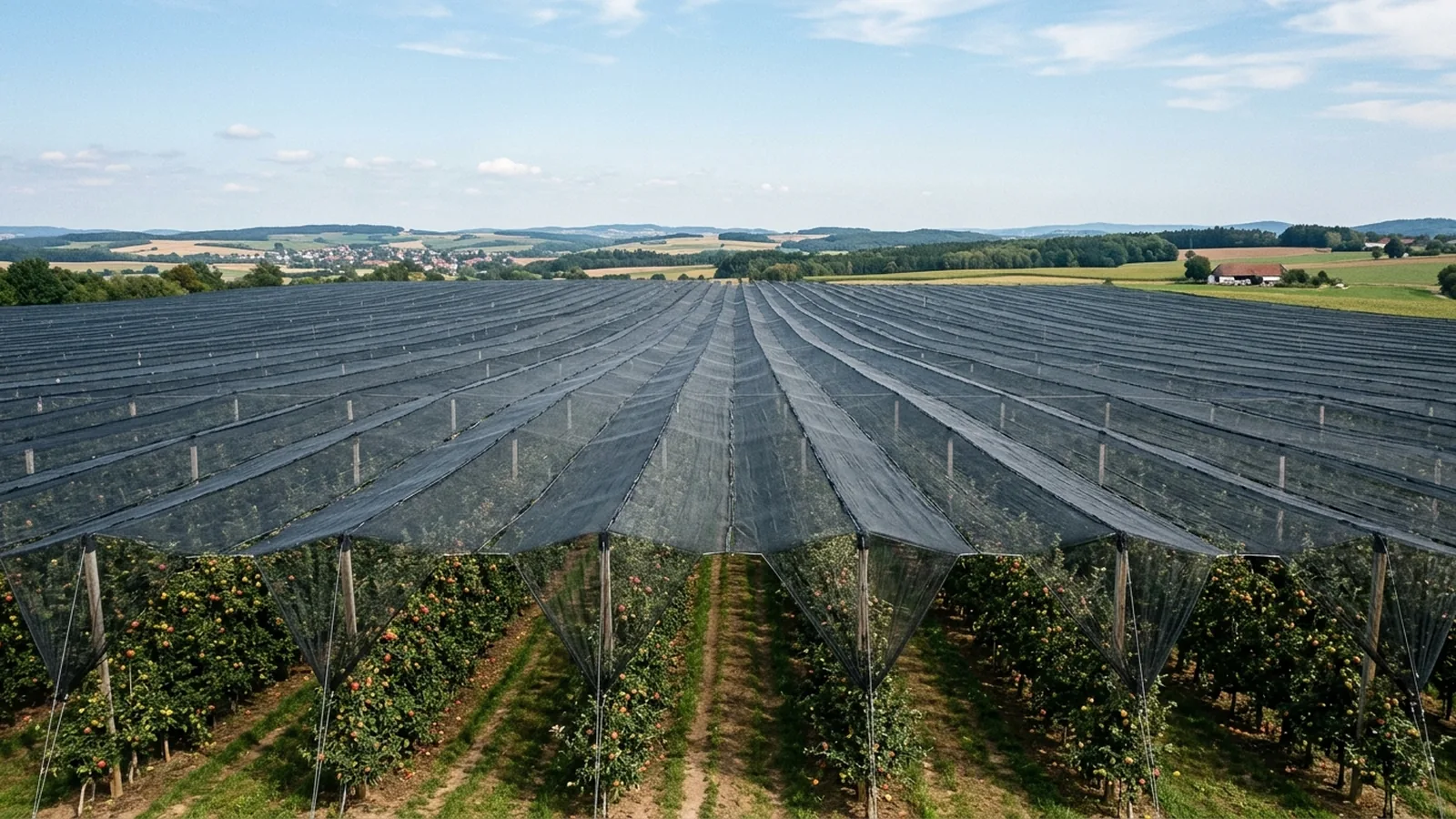
Hail netting color looks like a small detail until the first quote lands on your desk, at which point it stops being a detail and starts being six questions at once: black, white, gray, crystal, green, each at a different GSM, each with a different shade effect, and each at a different price. For an orchard buyer the useful question is never which color is best, since no color is best in the abstract, but what this particular color changes for this crop, in this climate, against the harvest target the block is graded on.
In short
Hail netting is not only a physical barrier. It also changes the light environment around the canopy. Depending on color, construction and density, it may affect:
- total light reaching the fruit
- heat around the canopy
- sunburn risk
- fruit color development
- worker visibility during harvest
- the visual impact of the orchard from outside
This is why a serious quote should not specify only “hail netting”. It should include color, construction, weight, mesh/opening, UV treatment, roll width and intended support system.
Use the Spec Builder if you want to turn those points into a cleaner RFQ.
Common color logic
White or crystal hail netting is often chosen when the grower wants protection while keeping as much light as practical. It can be a useful starting point when fruit color and light penetration are sensitive.
Black hail netting may be chosen for durability perception, glare reduction or simply because it is what the neighboring blocks use, and it can change the canopy light environment quite differently from a lighter net, which is a tradeoff some orchards absorb without noticing and others cannot afford at all. Which of the two you are depends less on the fabric than on what your fruit is paid for, so the question deserves a closer agronomic check before it is settled by habit.
Gray or mixed-color options sit between the two in many buying conversations. The exact effect still depends on the product, not just the name of the color.
Small warning from the purchasing desk: “white” from one supplier and “white” from another supplier are not automatically equivalent. Ask for the actual sample and the specification sheet. Color names are not engineering data.
What to ask before quoting
Before a hail netting quote, confirm these points:
- crop and variety
- row spacing and block dimensions
- local hail risk and expected event severity
- whether the net is for permanent seasonal use or removable use
- desired color
- support system type
- roll width preference
- edge reinforcement, selvedge or accessories
- UV treatment and expected outdoor life
If you skip these, you can still get a price. You just cannot know whether the price is for the right thing.
Where the research points
University and extension material does not treat hail netting as a simple commodity. For example, University of Minnesota Extension discusses hail netting for apple orchards as a management system, not only as a sheet of material. Research summaries also show that protective nets can influence orchard microclimate and fruit quality, depending on net properties and local conditions.
The published work goes further than “it can have an effect”, and the direction of that effect is what should worry a buyer growing a red variety.
Darker nets are reported to cost color development
Across the apple netting literature, darker nets, gray and black, are associated with poorer red blush and lower soluble solids than lighter treatments. We are reporting the direction the published work points in, not a number for your block. If your fruit is graded and paid on overcolor, that direction is not an agronomic footnote: it is the difference between grades on a crop you successfully protected from hail.
Net color and installation timing interact
Comparisons between net colors in high-density apple are run with a defined installation date relative to full bloom, because the two variables are not separable. If you are comparing quotes on color alone, you are comparing one half of the decision.
Photoselective nets are being trialled for a different reason than hail
Washington State University’s work on Honeycrisp in Quincy, WA reports reduced sunburn incidence, improved fruit size, lower wind speed under the net and improved vegetative growth. In a sunburn-limited block, the net may be earning its keep on something other than hail, which changes how you value it.
None of this converts into “buy white”. It converts into a question your supplier should be able to answer: what does this fabric, at this weight and construction, do to light at my canopy? A color name does not answer that, and neither does a research paper about a different net.
Useful starting references:
- University of Minnesota Extension: Hail netting for apple orchards
- SARE project LNC23-487: Apple orchard hail netting research
- Horticulturae review article on protective netting and fruit crops: Protective netting in fruit production
- Photoselective protective netting and Honeycrisp fruit quality, Plants 9(12), 2020: DOI 10.3390/plants9121708
- Washington State University Tree Fruit: Photoselective anti-hail netting trial for Honeycrisp apple
- Review of current knowledge and research gaps on hail netting in apple orchards, Climate 13(10), 2025: DOI 10.3390/cli13100203
Buyer takeaway
Do not buy hail netting by color alone. Buy the color as one line of a full orchard protection decision that also holds the crop, the climate, the light at the canopy, the structure and the installation date, because each of those moves what the color is worth and none of them appears on a swatch. If the supplier cannot explain how color, GSM, UV treatment and support system fit together, the quote is still incomplete however precise its number looks. Ask for a documented spec before you compare prices.
Frequently asked questions
Does hail netting color affect fruit quality?
Yes, and it is documented. Hail netting changes the light environment around the canopy, affecting total light reaching the fruit, heat, sunburn risk and color development. Published apple trials associate darker nets with poorer red blush and lower soluble solids. If your fruit is paid on overcolor, net color is a grading risk, not a cosmetic choice. The size of the effect still depends on the specific fabric, not on the color name.
Which hail netting color should an orchard choose?
The useful question is not which color is best, but what the color changes for your crop, climate and harvest target. White or crystal is often chosen to keep as much light as practical; black may be chosen for durability perception or glare reduction.
Is "white" hail netting the same from every supplier?
No. White from one supplier and white from another are not automatically equivalent. Ask for the actual sample and the specification sheet: color names are not engineering data.
What should a hail netting quote include besides color?
Color, construction, weight, mesh or opening, UV treatment, roll width and the intended support system. A quote that specifies only "hail netting" is incomplete.