Anti-hail netting for orchards: specs buyers should confirm
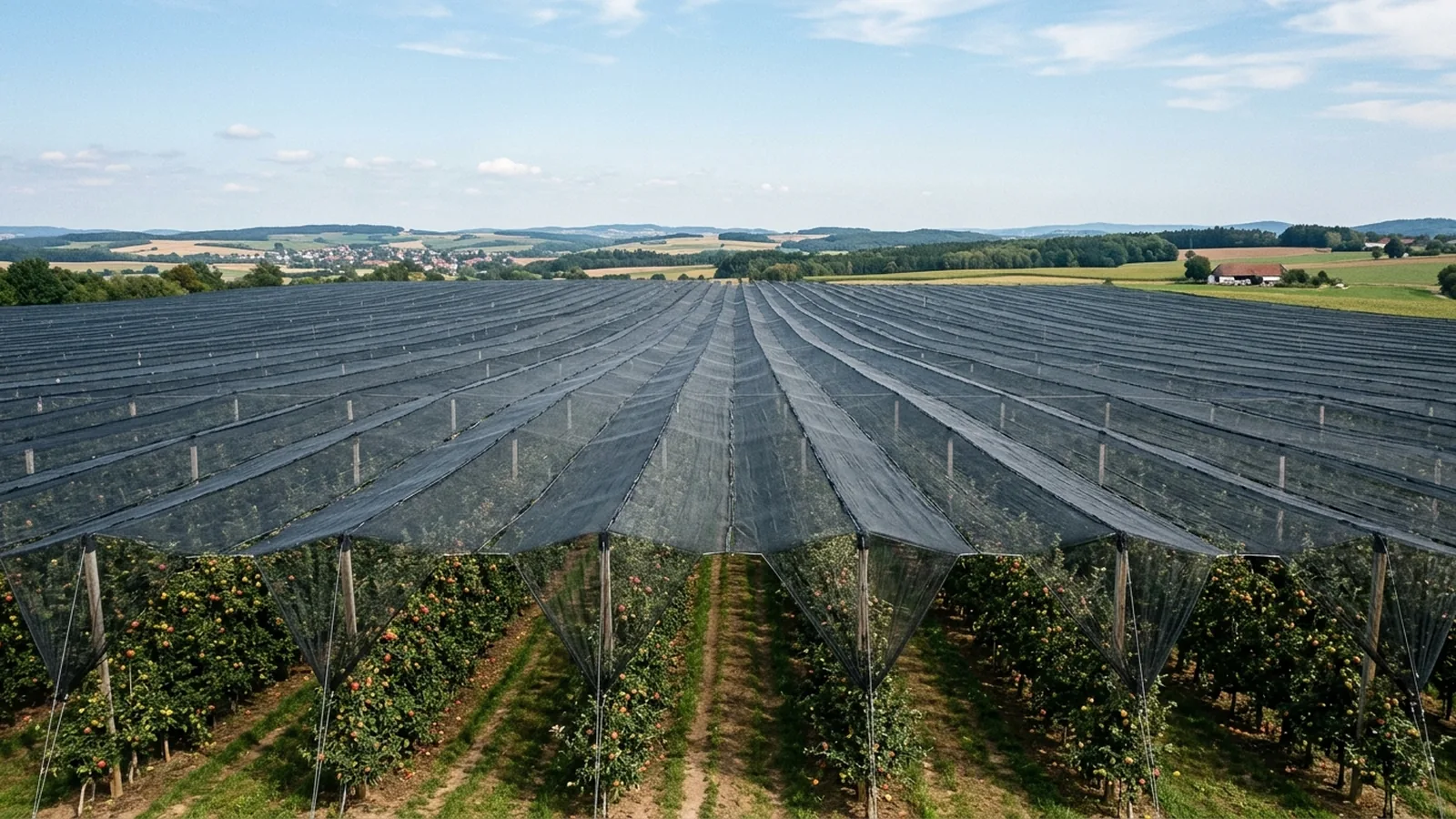
Anti-hail netting is easy to describe and easy to under-specify, because the description takes one line, a protective mesh held above the crop, while the specification runs to a dozen and decides whether the installation is still working in its third season. For orchards and vineyards the fabric is only one part of the system: the support structure, the panel format, the color, the tensioning and the installation method between them settle whether the net can do the job it was bought for, so a quote that prices the fabric alone has priced the smaller half of the problem.
In short
For an anti-hail netting quote, confirm the crop, row spacing, panel dimensions, expected hail exposure, net weight, mesh size, color, UV treatment, support structure and fixing method. A net without a structure is not a hail-protection system. It is just an optimistic fabric.
What anti-hail netting has to do
Anti-hail netting must absorb and distribute impact before hail reaches fruit, leaves and branches. It also has to survive UV exposure, wind, tensioning and repeated seasonal use.
That means the buyer should not only ask “how much per square meter?” A useful quote needs to define the system assumptions:
- what is being protected;
- how the net is supported;
- how it is tensioned;
- how water, light and airflow are handled;
- how the panels are joined or fixed;
- how long the installation is expected to remain in service.
Core specifications to confirm
| Specification | Why it matters |
|---|---|
| Material | Most anti-hail products are UV-treated HDPE; confirm material and stabilization. |
| Weight | Common catalog ranges often sit around 50 to 100 gsm, but final weight depends on exposure and structure. |
| Mesh size | Affects light, airflow, strength and hail behavior. |
| Color | Can influence light environment and fruit response. |
| Width and panel format | Must match row spacing, posts and installation method. |
| UV treatment | Outdoor lifespan depends heavily on stabilization. |
| Fixing accessories | The net alone is not the complete system. |
Use the hail netting specifications page as a starting point, then prepare a full request with the RFQ Spec Builder.
Color is not decoration
Color changes the light environment under the net, and in an orchard that reaches well past appearance: the light that gets through bears on fruit color development, on sunburn risk in the exposed rows and on the microclimate the tree sits in through the hottest weeks of the season, which is why white, black and gray systems stop being interchangeable the moment you look past the mesh size they happen to share.
Local experience carries real weight here. A configuration that has proved itself in one region under one light regime is a reasonable place to start the conversation elsewhere, and a poor substitute for asking what has actually held up in yours.
The support structure question
When a buyer says “I need hail netting”, the next question should be: over what structure?
The quote needs to know:
- Orchard or vineyard layout.
- Row width and length.
- Post spacing and height, if existing.
- Whether the system is flat, pitched, draped or otherwise configured.
- Wind exposure.
- Whether accessories are needed.
If those answers are unknown, the honest quote separates the netting supply from the structural design, because the two carry different risks and different liabilities: we can specify and source the fabric against a written set of figures and hold that figure in a contract, while the engineering that keeps it in the air has to be confirmed against the actual site, its wind exposure and whatever posts are already standing in it. Quoting both as a single number hides which half is a commitment and which half is an assumption.
What not to buy blind
Do not buy anti-hail netting from a photo and a square-meter price alone. At minimum, ask for:
- material;
- gsm;
- mesh size;
- UV treatment;
- color;
- roll or panel dimensions;
- packing;
- MOQ;
- lead time;
- what is included and excluded from the quote.
If the answer is “standard hail net”, ask again. “Standard” is not a specification; it is a napkin wearing a hard hat.
Sources
- University of Minnesota Extension, “Hail netting in apple orchards”, commercial fruit production guidance on hail netting systems: https://extension.umn.edu/commercial-fruit-production/hail-netting-apple-orchards
- University of Minnesota / SARE project material on hail netting in apple orchards: https://projects.sare.org/sare_project/lnc23-487/
- Peer-reviewed/open-access research indexed at PubMed Central on hail netting, orchard pest exclusion and fruit damage context: https://pmc.ncbi.nlm.nih.gov/articles/PMC10711545/
- Product specifications should be confirmed against manufacturer catalog data before quoting.
This article gives quote-preparation guidance, not installation engineering advice. Final system design should be confirmed against orchard structure, weather exposure and local installation practice.
Frequently asked questions
What should an anti-hail netting quote confirm?
Crop, row spacing, panel dimensions, expected hail exposure, net weight, mesh size, color, UV treatment, support structure and fixing method. A net without a structure is not a hail-protection system.
Is the netting alone a complete hail-protection system?
No. The support structure, panel format, tensioning and fixing method decide whether the net can do the job. If the site details are unknown, an honest quote separates the netting supply from structural design.
What weight of anti-hail netting is typical?
Common catalog ranges often sit around 50 to 100 gsm, but the final weight depends on hail exposure and the support structure. Confirm gsm against the actual product before ordering.
Does anti-hail netting color matter in an orchard?
It can. Color affects the light environment under the net, which can matter for fruit color, sunburn risk and microclimate. White, black and gray systems are not interchangeable just because the mesh size looks similar.
Watch the explanation
Visit our YouTube channelVideos in English. Playing a video connects to YouTube.